Docs / Service & sales
Sales orders
A sales order records units, parts and labor sold to a customer, from draft to invoice. Fulfilling an order moves the units on it to the customer, and an invoice bills it.
The order list
Open Sales orders from the menu.
- The table shows each order's number, customer, date, status and total. Select a row to open the order.
- Searching: type the start of an order number.
- Filters: All (newest first), Draft, Open, Fulfilled, Invoiced and Closed.
Creating an order
- Select New sales order, choose the Customer, and select Create order. You can also start one from the customer's page with New sales order.
- The order number is assigned automatically, and the order starts as Draft.
- You're its Salesperson, shown under the customer. Someone else can be chosen under Edit.
- The customer's tax rate is applied, from the address their Tax by setting chooses (their first address unless set otherwise). See Customers.
- The order opens, ready for its lines.
Adding lines
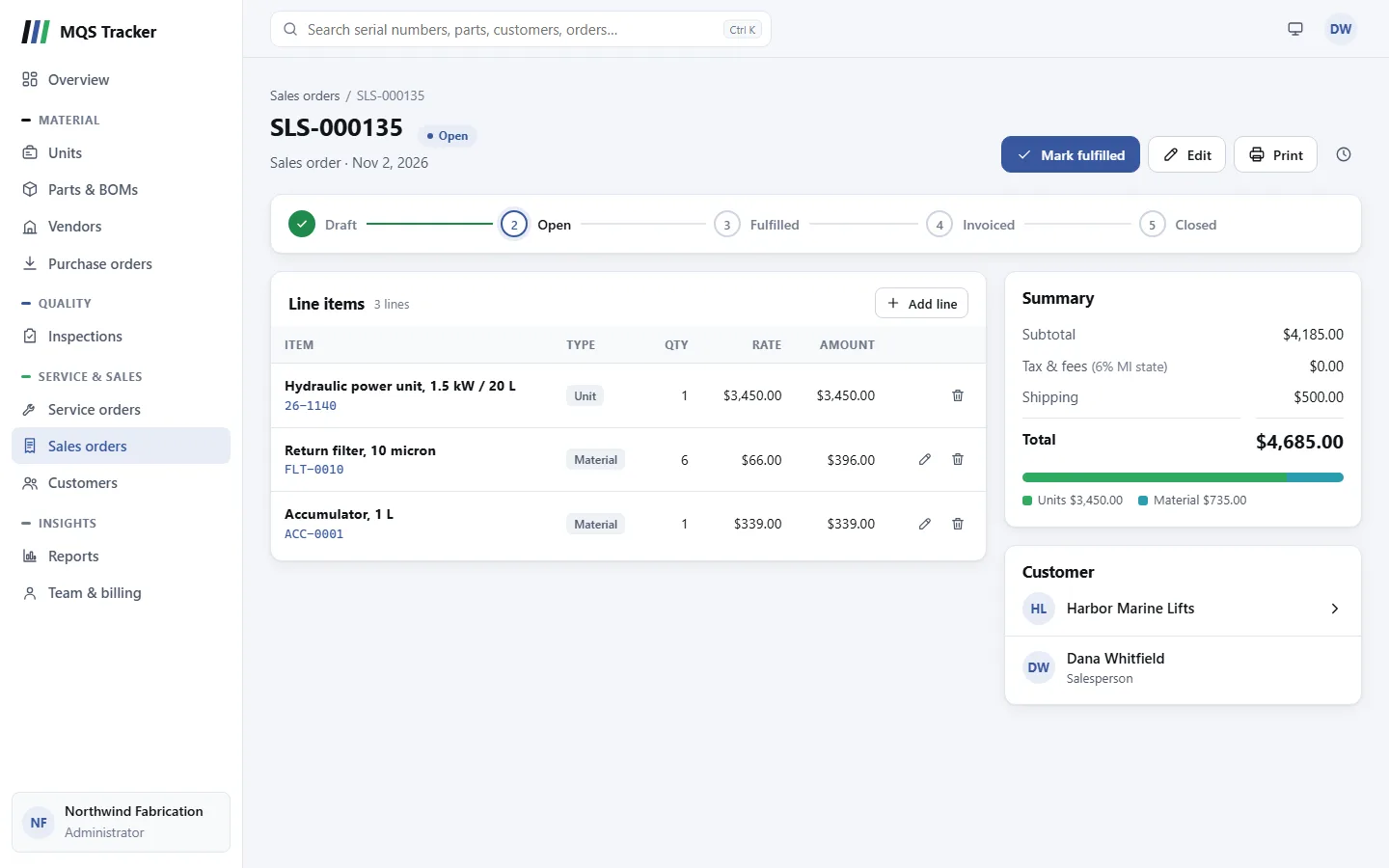
Select Add line, choose the Line type, and select Add line in the panel. The totals update straight away.
- Unit: enter or pick the Serial number. It's priced at the unit's standard price, and the quantity is always one. A unit can only be on an order once.
- Part: enter or pick the Part number and a Quantity. It's priced at the part's standard price.
- Labor: enter the Hours. It's billed at the customer's service labor rate.
- The line table shows each line's item, type, quantity, rate and amount. Serial and part numbers link to the unit or part.
Changing and removing lines
- Change quantity: the pencil button on a part or labor line. Unit lines have no quantity to change; remove the line and add another unit instead.
- Changing a line re-prices it: the line is worked out again at the part's current standard price, or the customer's current labor rate, with tax at the current rate.
- Remove line: the bin button on the line. The totals are recalculated.
Status steps
The steps across the top show where the order is: Draft, Open, Fulfilled, Invoiced, Closed. The main button at the top moves the order to the next step.
- Open order (from Draft): the order is confirmed. Part lines on open orders count toward each inventory part's Reserved quantity, which is worked out again when an order's lines change or the part is counted. See Parts and BOMs.
- Mark fulfilled (from Open): the order has shipped. The units on it now belong to the customer and appear in their installed base.
- Create invoice (from Fulfilled): starts an invoice for the customer with this order on it. Issuing the invoice marks the order Invoiced: its lines are locked, and the Summary card shows when it was Invoiced. The sales commission reports count the order from that date. Recording the invoice's payment closes the order. See Invoices.
- On an invoice: the order's page has a button for the invoice in place of the next step, and the Summary card links to it. While it's on an invoice that isn't void, the order can't be cancelled, moved back or given to another customer.
- Mark invoiced (under Edit, from Fulfilled): for an order billed outside MQS Tracker. It has the same effect on the order as issuing an invoice, and Close order (from Invoiced) then finishes it. The order can still go on an invoice later.
- Cancelled isn't a step. Set it under Edit, and the order shows "This order was cancelled." instead of the steps.
Some things to know:
- Fulfilling takes parts out of stock. The part lines come off each part's On hand; moving the order back to Open or cancelling it puts them back. See Parts and BOMs.
- Going back: if a fulfilled order goes back to Open, or is cancelled, its units go back to whoever owned them before. See who can do that below.
- Adding or removing a unit on a fulfilled order moves that unit straight away.
Who can change the status
- Forward: anyone can move an order one step forward, with the main button or under Edit. Steps can't be skipped.
- Back: an administrator can move an order one step back under Edit, but never from Invoiced back to an earlier step.
- Cancelling: anyone can cancel an order before it's invoiced. An administrator can also cancel an invoiced order, to replace it with a new one (void its invoice first, if it's on one). A closed order can't be cancelled.
- Reopening: an administrator can reopen a cancelled order; it starts again as Draft.
- Edit lists only the statuses you can move to from where the order is. Anything else gets a message saying why.
When an order is locked
- An order that's Invoiced, Closed or Cancelled has its lines locked: you can't add, change or remove lines, and the page says so.
Returns
When a customer sends back a unit or parts from an order that's Fulfilled or later, select Record a return on the order. Each line is inspected and an administrator approves what goes back to stock; the credit, if any, is a credit note against the invoice. While goods are on a return, the order can't move back before Fulfilled or change customer, and the returned lines can't be changed. The order's Returns card lists them. A Replacement order made from a return says so at the top, with a link to the return; a no-charge one prices every line at $0. See Returns.
- To change an invoiced order, an administrator can cancel it and you can create a new one. A closed order stays as it is.
Editing the order
Edit opens the order's details:
- Status: the statuses you can move the order to from where it is (see Who can change the status, above).
- Customer: changing it applies the new customer's tax rate to the order and its lines. If the order has been fulfilled, its units move to the new customer.
- Salesperson: who gets credit for the sale in the commission reports. It starts as whoever created the order, and can be changed to anyone on your team at any time, including after the order is invoiced.
- Select Save changes when you're done.
Sales commission
The Sales Commission report (SLS-060) shows each salesperson's net sales for orders invoiced in a date range: the line amounts, without tax, fees or shipping. Enter a Commission Percent to add the commission. Sales Commission Detail (SLS-070) lists the orders behind it. A sale counts in the period it was invoiced. If an invoiced order is cancelled later, the sale stays in its period and a reversal takes it back off in the period it was cancelled, so commission already paid is recovered from the next payment. The Summary card shows when a cancelled order was Cancelled. Reopening a cancelled order (back to Draft) removes both the sale and the reversal. See Reports.
Tax
- The Summary card shows the Subtotal, Tax & fees with the rate and its name, Shipping and the Total, plus how the amount splits between units, material and labor.
- The rate comes from the customer's address chosen by their Tax by setting: the first address, or the address marked billing or shipping. See Customers. If there's no rate for that address, the summary says "(no rate for the customer's address)" and no tax is charged.
- Where rates come from: sales tax rates by ZIP code, from Avalara's tables, updated each month. The rate is shown to up to three decimal places, such as 8.375%.
- What's taxed: units and parts marked taxable, and labor when the customer's Labor is taxable is ticked. Nothing is taxed for a Tax exempt customer.
- Tax is worked out per line, when the line is added or changed, at the price on the line. Saving the order under Edit works every line's tax out again for the customer's current rate and tax status, so changing the customer, or their address or tax exemption, updates the tax. An order that's invoiced, closed or cancelled keeps its tax unless you reopen it.
Printing an order
Print at the top opens the order in a print window, laid out as a document to hand or send to the customer:
- Your organization's name, address, phone and email (set under Team & billing), then the order number, date and status (and when it was invoiced).
- The customer, with their number, billing address and phone, a Ship to block when the shipping address is different, and the salesperson.
- The lines with their part or serial numbers, quantity, rate and amount, then the subtotal, tax and fees, shipping and total.
Choose a printer or Save as PDF in the print dialog. If your browser blocks pop-ups, the print dialog opens without the window. Any order can be printed, whatever its status.
Deleting an order
- Only a Draft order can be deleted: the bin button at the top deletes it and all its lines.
- Once an order is open, cancel it instead, so there's a record.
- The clock button shows the order's change history, including its lines.